Baku 19° C
Roadmap being prepared for final investment decision on Black Sea Energy Cable
- 24 October, 2026
- 16:00
Stay up to date with the top news!
The Caspian-Black Sea-Europe Green Energy Corridor initiative is currently at the stage of preparing tender documentation and developing a Roadmap for the adoption of the final investment decision (FID), Report informs, citing Green Energy Corridor Power Company (GECO).
The project is aimed at transmitting electricity generated from renewable energy sources in Azerbaijan and Georgia, including wind, solar and hydropower plants, to European Union member states. Once fully operational, the corridor's total capacity will reach 3.9 GW.
The corridor consists of three independent voltage-source converter (VSC) HVDC links operating at ±525 kV, each rated at 1,300 MW, giving 3,900 MW of transfer capacity at full build-out.
The Link 1, scheduled to be commissioned in 2032, will cover the Baku – Ksani – Anaklia – Constanța Sud; extended onshore from Constanța Sud to Albertirsa (HU) route, extending overland to the Albertirsa substation near Budapest, Hungary, with a capacity of 2,000 MW. The total length of this section will be approximately 3,040 km.
The Link 2, planned for 2036, will cover the Baku – Tskaltubo – Poti – Domneștiroute with a total length of about 2,340 km, while the Link 3, scheduled for 2040, will involve the Baku – Tskaltubo – Poti – Constanța Sud route, stretching approximately 2,020 km.
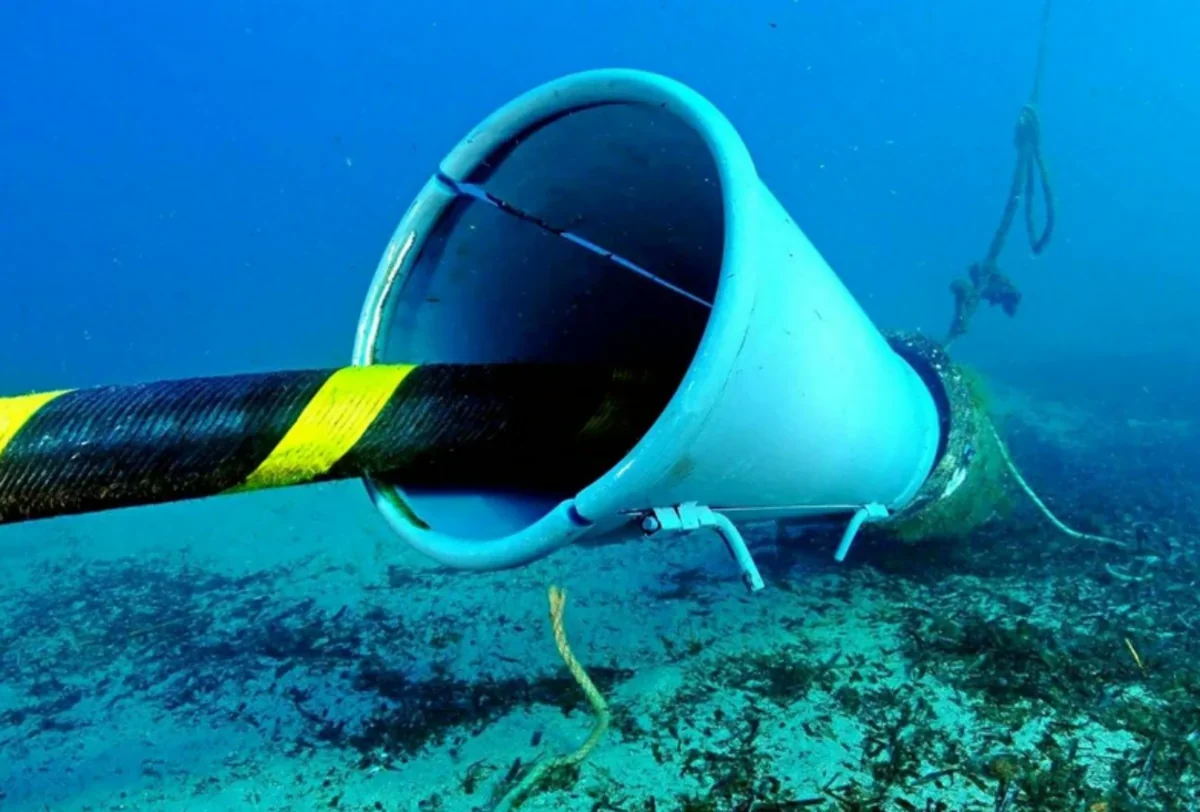
From the Georgian coast, submarine cables of about 1,120 km each cross the Black Sea, mostly over the abyssal plain at depths of up to about 2,200 meters, to the Constanța Sud landfall in Romania. In Romania and Hungary, the corridor connects to the EU grid at Constanța Sud, Domnești (Bucharest) and, through an onshore extension to Hungary, at the Albertirsa substation near Budapest.
Onshore converter stations in Ksani and Tskaltubo will provide a bidirectional connection between the corridor and Georgia's national power grid, allowing surplus electricity exports and electricity imports when needed.
The corridor infrastructure has been included in the European Network of Transmission System Operators for Electricity's TYNDP 2026 under project identifiers 1248 and 1244.
As part of the feasibility study, GECO also carried out a detailed assessment of a parallel green hydrogen pipeline from Azerbaijan to Hungary. The proposed pipeline would be approximately 3,000 km long, including a 1,115 km offshore segment, with estimated costs ranging from €6.6 billion to €13 billion.
However, based on the study's findings, project participants decided to temporarily suspend implementation of the hydrogen component and prioritize electricity transmission. The key reasons cited include significantly reduced forecasts for hydrogen imports by European consumers through 2040 and the stronger economic viability of HVDC transmission lines.
The hydrogen pipeline project remains a future option and may be reconsidered as the European Union's hydrogen market develops.
The Agreement on Strategic Partnership in the Field of Development and Transmission of Green Energy between the governments of Azerbaijan, Georgia, Romania and Hungary was signed in Bucharest on December 17, 2022, with the support of the European Commission.
Author