
 Baku 18° C
North Korea launches intermediate-range missile as elections loom for South
- 02 April, 2024
- 04:45
Stay up to date with the top news!
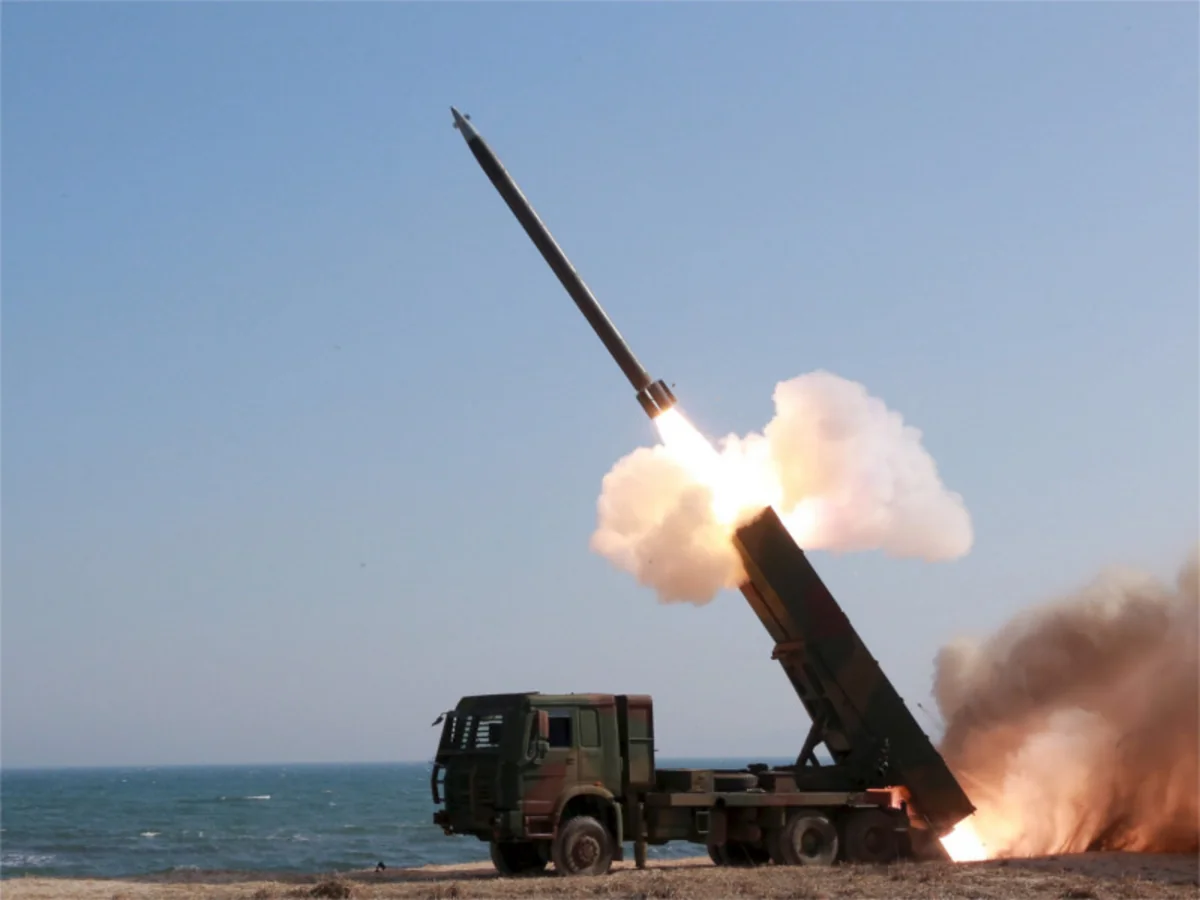
North Korea on Tuesday tested an apparent intermediate-range ballistic missile (IRBM) — possibly loaded with a hypersonic warhead — just over a week before a key general election in South Korea, Report informs via The Japan Times.
South Korean military officials said they suspected the launch, which would be Pyongyang's second IRBM test this year, may have been intended to gauge the weapon's performance after it tested a solid-fuel engine for a “new-type intermediate-range hypersonic missile” on March 19.
In January, the North also conducted a test of an IRBM loaded with what it said was "a hypersonic maneuverable controlled warhead."
"North Korea appears to have put a hypersonic warhead on top of the delivery system used in the engine test last month," an unidentified senior South Korean military official told the Yonhap news agency Tuesday.
Although the latest missile flew for less than 10 minutes, shorter than the flight time of past IRBM launches, its speed was similar to that of a hypersonic missile, the official added.
"(We) assess (Tuesday's launch) is connected to the solid-fuel ground test that North Korea made public in March," Yonhap quoted Col. Lee Sung-jun, a spokesperson for the South Korean joint chiefs of staff as saying.
"There is a possibility that the launch vehicle's capabilities have been enhanced," he added.
Japan's Defense Ministry also confirmed the launch of a ballistic missile from North Korea's western coast at 6:52 a.m., with the weapon landing in the Sea of Japan, outside of Japan’s exclusive economic zone, which extends 200 nautical miles (370 kilometers) from its coast.
The ministry, which did not identify the type of missile fired, said the weapon had flown 650 km, hitting a maximum altitude of 100 km before splashing down.
Prime Minister Fumio Kishida said Tokyo has "strongly protested" the move, adding that Japan was working with the United States and South Korea to analyze the latest launch — the North's first since March 18, when it fired off three ballistic missiles.
The North twice tested a missile carrying a maneuverable warhead, more commonly known as a hypersonic glide vehicle (HGV) or boost-glide vehicle, in January 2022.
HGVs are launched aboard missiles before separating and approaching a target. Contrary to its name, speed is not the key feature. Rather, it is the weapon's maneuverability: It can change trajectory during flight, making it difficult to intercept.
Nuclear-armed Pyongyang had widely been expected to continue ratcheting up tensions ahead of the April 10 general election in South Korea — and observers said weapons tests and military exercises could continue in the days ahead.
Official campaigning for that election began Thursday, with President Yoon Suk-yeol's ruling People’s Power Party aiming to win a parliamentary majority amid attempts by the opposition to leave him a lame duck for the remaining three years of his five-year term.
Yoon has taken a hard line against his country’s neighbor to the north, cementing ties with its ally, the United States, and dramatically improving security relations with Japan after bilateral ties plummeted to their worst in decades over history and trade issues.
Following Tuesday's launch, Yoon criticized the North for attempting to sow confusion as the South geared up for the election, adding that the move would only serve to unite his country.
Experts said the move would do little to sway voters.
"Firing an intermediate-range missile lacks the shock value of a full-range ICBM launch or a nuclear test, so it’s unlikely to swing any National Assembly seats," Leif-Eric Easley, a professor at Ewha University in Seoul, said, referring to one of the North's powerful intercontinental ballistic missiles capable of striking the US mainland.
Although Pyongyang’s weapons development remains a major concern, South Korean voters are "currently focused on health care reform, economic policies, and domestic political scandals," he added.
Author