Baku 16° C
Azerbaijan and Central Asia could become regional AI hub, Norov says
- 13 November, 2026
- 16:15
Stay up to date with the top news!
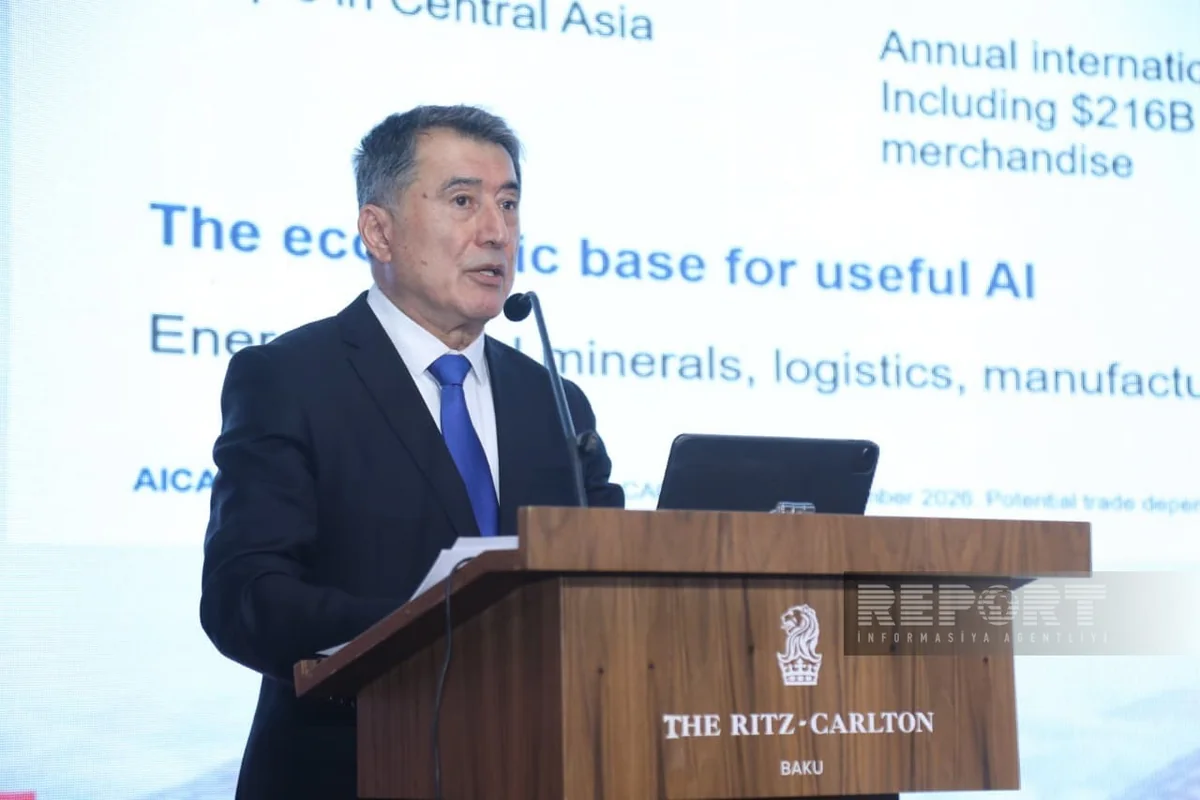
Central Asia and Azerbaijan could become a major regional hub for industrial artificial intelligence, data management and digital services, said Vladimir Norov, chair of the Central Asian Artificial Intelligence Association and a former foreign minister of Uzbekistan.
Report informs that Norov made the remarks at the second Artificial Intelligence Summit in Baku.
"Central Asia's annual foreign trade turnover is about $216 billion. With stronger ties between our countries, total trade could reach $500 billion. Energy, strategic minerals, transport, manufacturing and digital services could be the main drivers of that growth," Norov said.
He said Central Asian countries were working to build their digital capabilities and could start coordinating those efforts by making trade more predictable. Freight moving along the Middle Corridor, which links Central Asia to Europe via the Caspian Sea, the South Caucasus and Türkiye, depends on train schedules, port capacity, ferry operations and customs procedures. Norov said companies and public agencies could use digital tools to improve arrival estimates, reduce missed handoffs and spend less time resolving discrepancies in data.
Norov said the Trans-Caspian fiber-optic cable linking Aktau, Kazakhstan, directly with Sumgayit, Azerbaijan, adds a digital connection to the Middle Corridor and provides an alternative route for transmitting data westward to Europe.
"The cable can support electronic customs procedures, cargo tracking, smarter transport systems and cross-border services. Without those applications, it would serve little purpose and generate no revenue," he said. He added that the cable could make regional data connections more reliable and reduce dependence on a single route.
Citing a World Bank estimate, Norov said strategic investment and closer regional integration could more than triple trade along the Trans-Caspian Corridor by 2040 and cut travel times in half. He stressed that these were possible outcomes and would depend on coordinated investment, more efficient transport and digital tools that meet the needs of operators and customers.
Norov said digital infrastructure should support services that businesses, researchers and government agencies can use. He cited a study estimating that the Caucasus, Central Asia and nearby markets could generate demand for about 850 megawatts of data center capacity, compared with about 30 MW currently available in the region.
He said countries could bring together energy resources, fiber networks, cloud services, research and AI expertise, and share computing resources where practical. Each country could choose an infrastructure model suited to its needs, while sensitive data should be handled under clear national rules and with appropriate safeguards.
Norov said reliable electricity supplies would require investment in power grids, energy storage and cross-border connections as well as generation. He put Central Asia's renewable energy potential at 5,470 MW and said Azerbaijan had reported at least 2,000 MW of unused power capacity that could serve data centers. Azerbaijan's total generating capacity was about 10,000 MW and its electricity tariffs were competitive, he said, adding that available capacity and renewable potential alone could not guarantee reliable supply.
Norov called for data centers, power generation and grids to be planned together. He cited Azerbaijan's AZURE project, feasibility work for the Caspian Green Energy Corridor and the World Bank's regional electricity market program for Central Asia as starting points for joint planning and electricity trade.
He also urged developers to account for water scarcity when choosing sites. Data centers can use water directly for cooling and indirectly through the electricity they consume, he said. Site selection should take into account local water supplies, the proposed cooling system, opportunities to reuse wastewater and the potential impact on nearby communities.
Author