
 Baku 11° C
Azerbaijani President's visit to Vietnam: New horizons for partnership
- 25 November, 2026
- 11:45
Stay up to date with the top news!
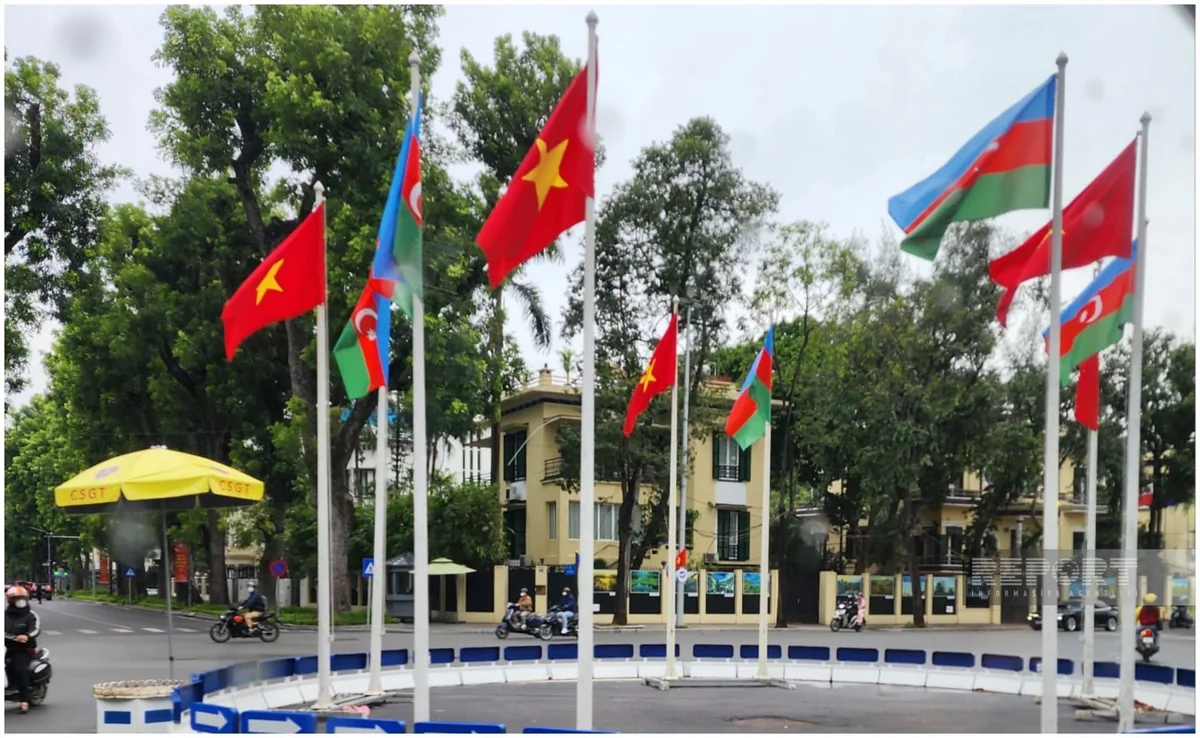
Hanoi greeted us with summer warmth, which felt like a welcome relief after the November weather in Baku. Streets lined with lush greenery, historic buildings standing alongside modern structures, and an endless stream of scooters – these were our first impressions of the Vietnamese capital, according to Report.
We traveled to this distant Asian country to cover Azerbaijani President Ilham Aliyev's official visit. The trip also provided us with an excellent opportunity to learn more about Vietnam, its historical heritage and its people.
The roots of bilateral ties
Relations between Azerbaijan and Vietnam date back long before the establishment of diplomatic ties. As early as 1959, during the Soviet era, Ho Chi Minh, president of the Democratic Republic of Vietnam, visited the Azerbaijani capital. In 1983, Vietnam hosted a Soviet delegation led by national leader Heydar Aliyev, who at the time served as First Deputy Chairman of the Council of Ministers of the USSR.
During the Soviet period, Azerbaijani universities also trained Vietnamese specialists, particularly for the oil and gas sector. Cultural ties developed as well. Azerbaijani film director Ajdar Ibrahimov worked in Vietnam from 1959 to 1962, contributing to the development of the Vietnamese film industry.
Official diplomatic relations between the two countries were established on September 23, 1992. Azerbaijan opened its embassy in Hanoi in 2013, and in 2025, relations between Baku and Hanoi were elevated to a strategic partnership.
Memorial to fallen heroes and martyrs
The first stop on our itinerary in Hanoi was the Memorial to Fallen Heroes and Martyrs. Azerbaijani President Ilham Aliyev laid a wreath at the monument. A guard of honor was also stationed at the memorial.
The memorial is located on Bac Son Street, close to Ba Dinh Square and opposite the Ho Chi Minh Mausoleum. It commemorates those who lost their lives fighting for Vietnam's independence and freedom.
The complex was built in 1993–1994 based on a design by Vietnamese architect Le Hiep. Its minimalist architecture combines strict geometric forms with elements inspired by traditional Vietnamese memorial sites.
Ho Chi Minh Mausoleum
Our next stop was the Ho Chi Minh Mausoleum in Ba Dinh Square. The Azerbaijani president paid tribute to the Vietnamese leader and laid a wreath at the mausoleum, where a guard of honor was also on duty.
The mausoleum was officially opened in 1975. It houses the body of Ho Chi Minh, president of the Democratic Republic of Vietnam, under whose leadership the country declared independence in 1945. It was here, in Ba Dinh Square, that he proclaimed the Declaration of Independence.
Meetings with Vietnam's leadership
The central event of the visit was Ilham Aliyev's talks with Vietnamese President To Lam. The meetings resulted in the signing of a joint statement by the two leaders, followed by a ceremony for the exchange of bilateral documents in their presence.
The agreements cover cooperation in firefighting and rescue services, interaction between the Presidential Administration of Azerbaijan and the Office of the President of Vietnam, as well as joint projects in renewable energy.
The joint statement outlines five priority areas: political and diplomatic relations; the economy, trade, energy, agriculture and transport; defense and security; education, culture and tourism; and multilateral cooperation.
The visit marked a new stage in strengthening the strategic partnership between Azerbaijan and Vietnam. The joint statement and agreements reached during the visit lay the groundwork for further expanding political dialogue, trade and economic cooperation, and collaboration in the energy sector. For Baku, closer ties with Hanoi are part of its multivector foreign policy, while for Vietnam, they offer a gateway to the markets of the South Caucasus and Central Asia.
Beyond the official agenda
Our trip to Hanoi gave us an opportunity not only to cover official events but also to explore the city and learn more about its history.
One place that offered a particularly deep insight into Vietnam's past was Hoa Lo Prison. Now a museum, the former prison tells the story of the colonial era, the struggle for independence and the lives of those who were imprisoned there.
The prison was built by French colonial authorities in the late 19th century. It held Vietnamese patriots and members of the resistance against colonial rule. Today, visitors can see the prison cells, shackles, inmates' personal belongings and the guillotine used to carry out death sentences.
A separate section of the exhibition is dedicated to female prisoners. Confined in cramped cells, they lived side by side, slept on concrete platforms and shared the meager supplies sent by their families. Among them was Nguyen Thi Quang Thai, the first wife of future General Vo Nguyen Giap. She died while imprisoned there.
According to former inmates' accounts, women with young children were also held at the prison. The memoirs of one former prisoner recount an incident in which a child barely over a year old was imprisoned alongside his mother.
Despite tight security and high walls, inmates repeatedly attempted to escape. In March 1945, taking advantage of the chaos during the transfer of power from the French administration to the Japanese, more than 100 political prisoners escaped through an underground sewer. Another daring escape took place in December 1951, when 16 inmates made their way out through the sewage system after sawing through the bars. Five managed to get away, while the others were recaptured.
Hoa Lo's history also has another chapter. From 1964 to 1973, captured American pilots were held there. A section of the museum exhibition is dedicated to this period as well.
The museum grounds also feature a memorial area where visitors can burn incense in memory of the prisoners who died there. It is a place to pause for a moment and pay tribute to those whose lives ended behind prison walls.
A city of contrasts and traditions
Vietnam's historical past is visible throughout the streets of Hanoi. Red flags, Communist Party symbols featuring the hammer and sickle, portraits of Ho Chi Minh, and schoolchildren wearing bright red pioneer scarves all catch the attention of visitors. A monument to Vladimir Lenin also stands in one of the squares in the city center. The bronze statue was erected in 1985 in a park in Ba Dinh Square, not far from the Ho Chi Minh Mausoleum. Notably, Vietnam is one of only five countries in the world where a communist party remains in power.
One of the most striking features of Hanoi's cityscape is its abundance of greenery. Broad canopies of deciduous trees mixed with palm trees form a green framework throughout the city. Interestingly, trees and shrubs can even be seen growing on the balconies of residential buildings.
There is another feature of the Vietnamese capital that is impossible to miss from the moment you arrive: the sheer number of scooters. They seem to be everywhere, filling the streets and weaving through traffic. Vietnam has more than 70 million motorcycles and scooters, making it one of the countries with the highest numbers of two-wheeled vehicles in the world. In Hanoi, they are the primary means of transportation for most residents. Pedestrians need to be particularly careful when crossing the streets. Experienced travelers advise walking slowly and predictably, allowing the steady stream of scooters to flow around you.
The city does not wind down after sunset. Young people gather in the streets, while residents stroll, socialize and spend time at the many cafes. If you ever visit Hanoi, be sure to make time for a walk along Hoan Kiem Lake, a sacred body of water in the heart of the city associated with an ancient legend about a magic sword and a golden turtle. As colorful lights shimmer on the water and the city's fountains come alive, Hanoi takes on an almost magical atmosphere.
Near the Hanoi Opera House, an unusual installation caught my attention: metal trees with flowers, leaves and birds adorning their branches. The artwork, titled "Unity," is dedicated to the solidarity of the Vietnamese people in their struggle for independence – a struggle that lasted for decades and culminated in the country's reunification in 1975.
Vietnamese cuisine also deserves special mention. There is plenty to try for lovers of fish and seafood, while one of the country's best-known dishes is pho, a soup made with rice noodles. It is a true national symbol: an aromatic broth simmered for six to 12 hours with spices such as star anise, cinnamon and cardamom, then served with thin rice noodles, fresh herbs and meat.
Vietnamese coffee is another favorite among tourists. The country ranks second in the world in coffee bean exports, after Brazil. One particularly noteworthy variety is egg coffee (cà phê trứng), an unusual drink for those unfamiliar with it, topped with a sweet, airy foam made from whipped egg yolk and condensed milk. It was invented in Hanoi in 1946 by bartender Nguyen Van Giang, when the country was experiencing a milk shortage.
Overall, Vietnam left us with memories of warm hospitality, the genuine smiles of its people and the extraordinary beauty of its natural landscapes. Hanoi is a city that cannot be fully understood in a single visit, but one that leaves a lasting impression on everyone who travels there.
Author