Baku 23° C
Azerbaijan's secular state model receives support on Turkish social media
- 15 October, 2026
- 20:24
Stay up to date with the top news!
What does a strong Azerbaijan mean for Türkiye: an equal ally, or a partner expected to coordinate every decision in advance? The debate that began in segments of the Turkish media and social networks over school attire in Azerbaijan has, in fact, brought this question to the fore as well.
Around 25 years ago, a Turkish diplomat told us: "Azerbaijan is our brotherly country. We do not want Azerbaijan to be a burden on Türkiye's shoulders. We want to see an Azerbaijan strong enough to stand shoulder to shoulder with Türkiye and move forward together."
At the time, Azerbaijan was a young independent state living through the severe consequences of war, with its territories under occupation and economic capabilities far below today's level. Today, however, the Azerbaijan that diplomat described has become a reality.
Azerbaijan is a state that makes major investments in Türkiye, assumes responsibility in joint energy and transport projects, and stands by the brotherly country in difficult times. The Azerbaijan neighborhood established in Kahramanmaraş after the earthquake is a concrete example of this relationship. Here, brotherhood is expressed not only through political statements, but in the rebuilt lives of people.
Azerbaijan takes the same approach when defending Türkiye's position on international platforms. It is no coincidence that President Ilham Aliyev's words, "Türkiye is not here, but I am here," have remained in people's memories. It was a political stance demonstrating that the relationship is not based on one-sided support.
This is also the logic behind relations being elevated to the level of an alliance through the Shusha Declaration: two independent states that strengthen each other's capabilities and contribute to one another's security and future.
That is precisely why attempts to instruct Azerbaijan from outside or demand explanations for its domestic decisions raise a legitimate question: are those who wanted a strong Azerbaijan also prepared to accept its independent will?
From school attire to political pressure
Discussions over dress rules in Azerbaijani schools have gone beyond the boundaries of education in statements by some political figures and media circles in Türkiye. Reactions from Oktay Saral, senior adviser to the Turkish president, and some AKP representatives show that the issue is not merely a polemic involving anonymous social media accounts.
At the same time, it would be wrong to equate the views of individual political figures with the position of the Turkish state or Turkish society as a whole. On the contrary, there are posts on social media criticizing this approach and calling for respect for Azerbaijan's domestic affairs.
The problematic aspect of the debate is that attitudes toward a specific school rule have been replaced by judgments about Azerbaijan's overall political course. A discussion that began with clothing has expanded to include Azerbaijan's foreign partners, the Karabakh war and sectarian differences.
The fact that these issues are being combined in the same dispute shows that, for some participants, the discussion is no longer about education. Instead, it is about what decisions Azerbaijan should make, with whom it should cooperate and which political expectations it should follow.
It is at this point that the boundary becomes clear between expressing an opinion and attempting to impose one's will on the other side.
Objections coming from Türkiye itself
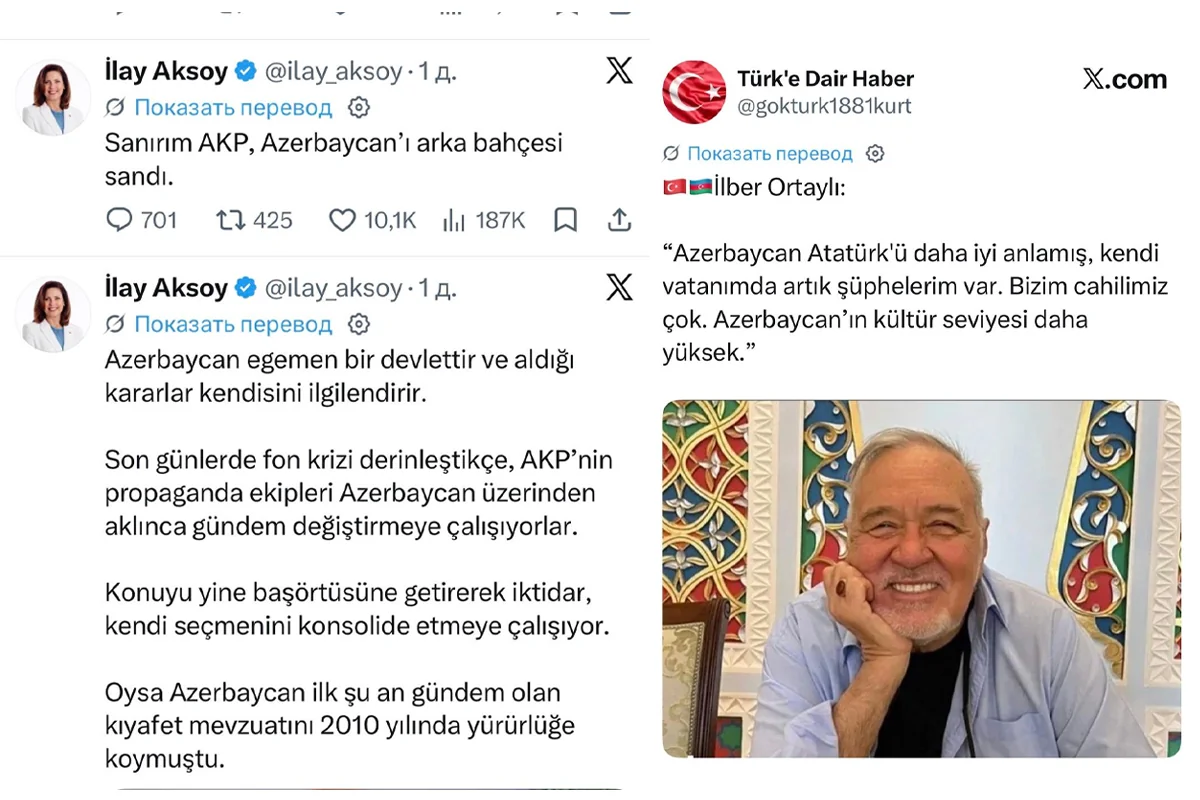
A post by İlay Aksoy on X directly articulates this boundary: "Apparently, the AKP considers Azerbaijan its own backyard."
This is the author's political assessment. However, the issue she raises is broader: is Azerbaijan being addressed as an equal sovereign state, or is it expected to behave in accordance with someone else's wishes?
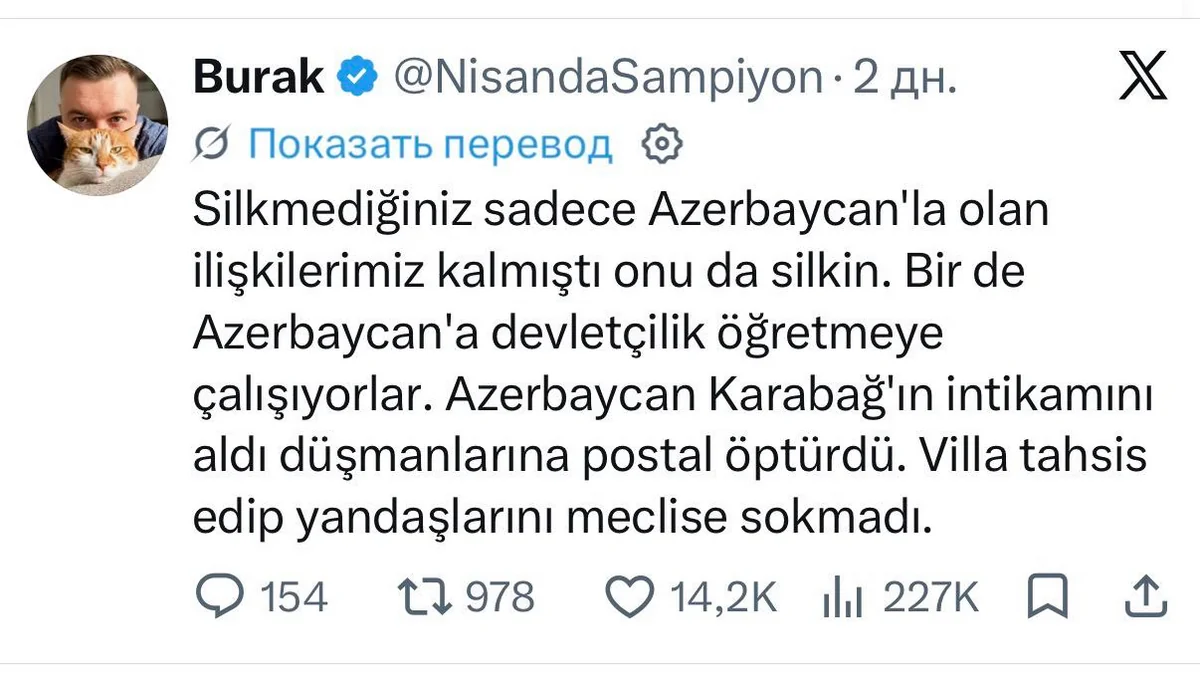
Another user, Burak, drew attention to the risk of damaging relations and objected to attempts to lecture Azerbaijan on statehood: "And now they are even trying to teach Azerbaijan statehood."
The significance of these reactions lies in the fact that they are coming from within Türkiye's own information space. Users defending Azerbaijan do not see pressure on Baku as a way to protect brotherhood. Instead, they argue that precisely such an approach could damage relations.
It would be wrong to draw conclusions about an entire society from individual posts. But these examples clearly show that those targeting Azerbaijan cannot claim to speak on behalf of all of Türkiye either.
"One nation" should not make us forget "two states"
In the phrase "One nation, two states," which has become the central expression of relations between Azerbaijan and Türkiye, both parts are equally important.
A shared identity, history and spiritual closeness do not eliminate political independence. On the contrary, brotherhood requires the two states to be even more sensitive toward each other's choices.
It is possible to disagree with Azerbaijan's decisions. But such disagreement cannot be used to question its right to make independent decisions.
If brotherhood is presented on the condition that "you must act as we say," it is replaced by a claim of superiority. Such an approach does not strengthen mutual trust; it instead forces one side to constantly explain its independence.
Azerbaijan has no obligation to obtain political approval from outside for every domestic decision it makes.
Inheriting and protecting a secular state
Another dimension of support for Azerbaijan on social media concerns the country's secular state model.
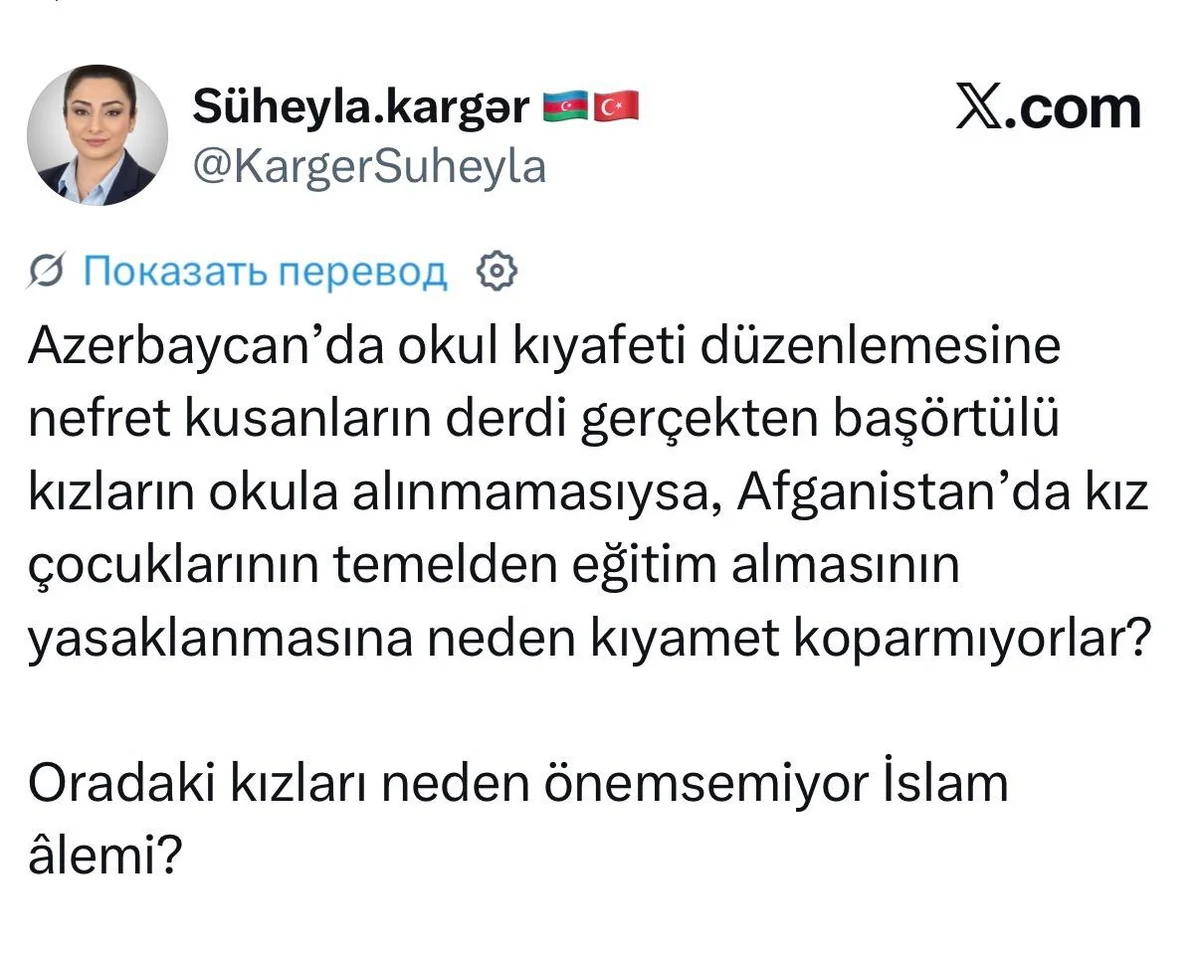
A user named GÜL, sharing footage of students in Azerbaijani schools singing the national anthem in uniform, wrote: "You are magnificent, Azerbaijan!" An account named Uzaktan Gelen raised the issue of supporting Azerbaijan in preserving its Turkic identity and cultural heritage.
In these posts, Azerbaijan is viewed as a country defending its own public order, national identity and path of statehood.
Inheriting secular state institutions from previous generations does not guarantee their preservation. Doing so requires political responsibility and consistency. When schools, public administration and general public rules become arenas for competition among political-religious groups, that legacy can weaken.
Those proposing a different path for Azerbaijan should also explain the consequences of that path. Does it improve the quality of education? Does it unite society? Does it strengthen trust in state institutions? Or does it divide people according to clothing, faith and lifestyle?
Religious slogans do not substitute for economic prosperity, quality education or fair governance. The success of a state is measured by how its citizens live and how confidently they look toward the future.
Azerbaijan is under no obligation to repeat the same disputes experienced by others. Drawing lessons from its own experience and developments in other countries, it has a responsibility to preserve its secular model.
This is not a stance against faith. The task of a secular state is to ensure that people of different beliefs can live within the same institutions with equal rights and opportunities.
Schools should not become arenas of political confrontation
Schools are common spaces for children from different families and with different worldviews. Their primary purpose is to provide knowledge, support children's development and help them integrate into society.
For this reason, in debates over school rules, the interests of the child should take precedence over the positions of political groups. What effect does circulating images of schoolchildren and turning them into symbols of confrontation have on their education and psychological well-being? Adults who speak in their name should also answer this question.
Respect for a family's beliefs, continuation of a child's education and enforcement of common school rules must be reconciled responsibly. Children themselves should not become instruments in political disputes among adults.
A clear, consistent approach centered on children's development is also what strengthens Azerbaijan's secular education policy.
Support over Karabakh should not be turned into political debt
Bringing the Karabakh issue into a dispute over school attire is particularly inappropriate. Comments along the lines of "if it were not for us..." turn brotherly support into a means of making political demands afterward.
Azerbaijan highly values Türkiye's support. But that support cannot serve as grounds to diminish Azerbaijan's own struggle, the sacrifices it made or its determination to decide its own destiny.
At the same time, Azerbaijan's support for Türkiye has never been limited to words. From joint projects to solidarity shown in difficult times, the relationship has always involved reciprocity. Recalling this is important not for keeping score, but for demonstrating that brotherhood is not a one-sided dependency.
Assistance from either side does not create a right to control the other's future decisions. Gratitude does not mean surrendering independence.
Bringing sectarian differences into this dispute is equally harmful. Reassessing the bonds between Azerbaijan and Türkiye on the basis of people's religious affiliation means misunderstanding the very nature of those ties.
Accepting a strong Azerbaijan together with its independent will
The Azerbaijan that the Turkish diplomat envisioned years ago - one capable of moving forward shoulder to shoulder with Türkiye - exists today. Such a state contributes to its partners, assumes responsibility and makes its own decisions.
Wanting a strong ally while expecting it to voice only pre-approved opinions is a logical contradiction. Accepting Azerbaijan's strength also means accepting its independent will.
This is precisely why the message of those in Türkiye who oppose attempts to pressure Azerbaijan is important for the future of bilateral relations. They see the protection of brotherhood not in interference in the other side's domestic affairs, but in respect for its sovereignty.
Azerbaijan is nobody's backyard. It is an independent ally that stands alongside Türkiye and moves forward shoulder to shoulder with it. The strength of brotherhood lies precisely in that equality.
Author