
 Baku 23° C
ADB Vice President: Our focus will be on the areas where we can add the most value - INTERVIEW - VIDEO
- 29 May, 2019
- 05:00
Stay up to date with the top news!
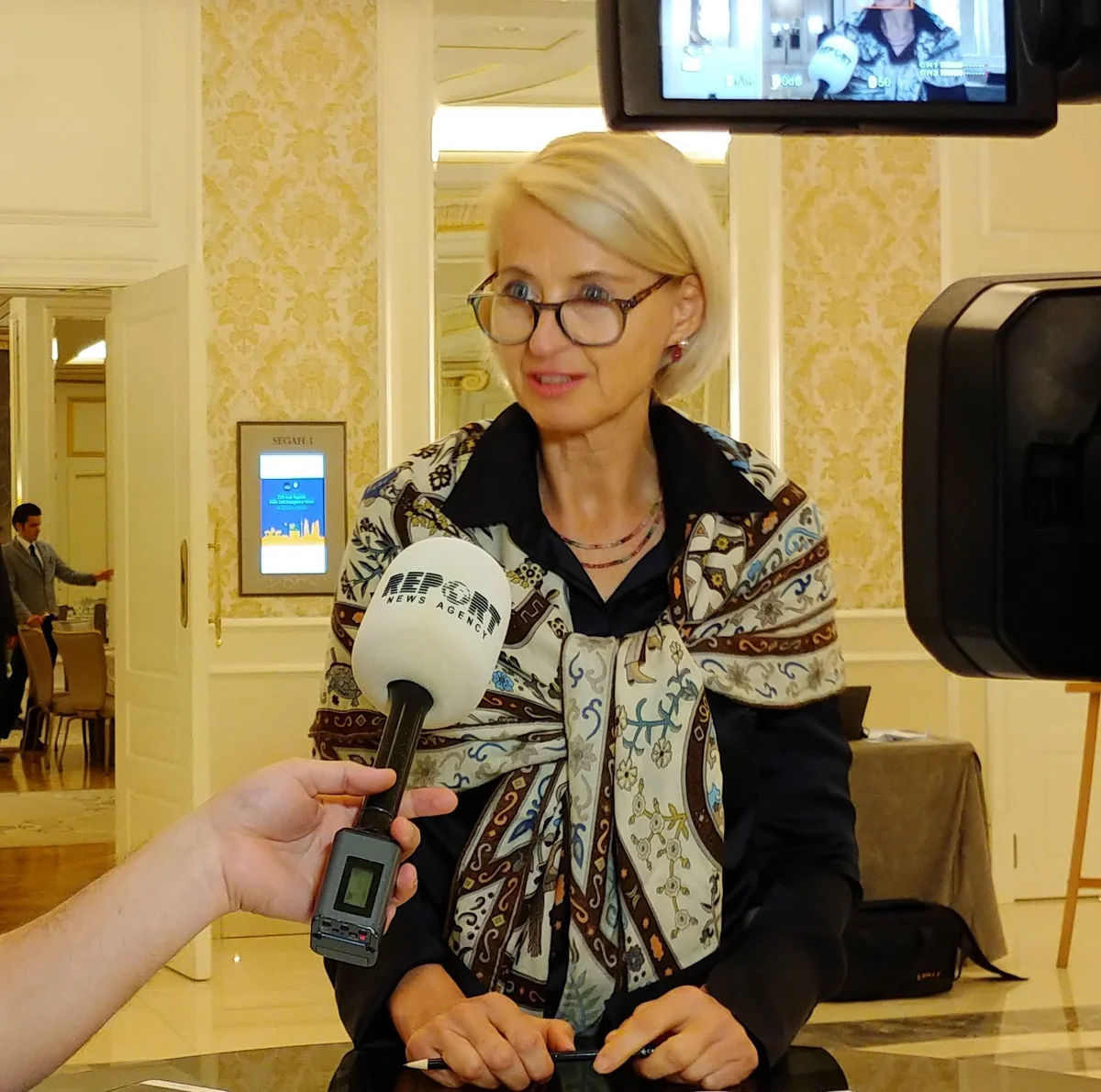
Report's exclusive interview with Ingrid van Wees, Vice President of the Asian Development Bank on Finances and Risk Management, who paid her first visit to Azerbaijan last week.
Ms. Vice-President, Welcome to Azerbaijan.
What is the objective of your visit?
My main purpose is to join the 2019 Asian Regional Public Debt Management Forum, which ADB co-hosts with the Ministry of Finance, Azerbaijan in Baku. The forum seeks to: (i) strengthen the sustainable public debt management of ADB member countries, (ii) promote capacity building through knowledge-sharing, and (iii) facilitate networking among public debt managers in the region. The Forum has become as annual event which serve as an opportunity for government counterparts to exchange views and discuss developments on issues related to public debt management. Given the central role of public debt management, this is a key area in which ADB can provide assistance to Asian and Pacific countries. I am happy to note that over 130 participants from 36 ADB members across the Asian & Pacific region will be attending this year’s Forum.
What are the expectations from your meetings with Government officials and representatives of private sector?
One of operational priorities of ADB’s Strategy 2030 (our long-term corporate strategy) is to scale up our private sector operations. By 2024, ADB’s private sector operations are expected to reach one third of ADB’s annual investments in terms of number of deals. Given this and the strong demand from the stakeholders in Azerbaijan, the new proposed Country Partnership Strategy for Azerbaijan for 2019–2023 envisages raising ADB’s private sector operations in the country. As VP responsible for Finance and Risk Management, I take the opportunities of visits to ADB member countries to get a first-hand understanding of the ecosystem for business and private sector investments. In this regard, the visit to Azerbaijan is particularly opportune given the start of your new five-year country partnership cycle.
What is your assessment of public debt management in Azerbaijan?
ADB welcomed the approval of Debt Management Strategy (DMS) in August 2018. ADB’s ongoing programmatic technical assistance project supports the government in implementing the DMS. The DMS sets to ensure sustainable and sound public debt management, and the fact that it is explicitly aimed at further strengthening the country’s financial sustainability. This includes: (i) reducing costs and better managing risks; (ii) establishing necessary limits, ceilings, restrictions, and quantitative targets on foreign currency and variable rate borrowing to minimize currently high exposures, and on the issuance of loans and state guarantees to SOEs and financial institutions; and (iii) upgrading oversight mechanisms. One of DMS’ key objective is the development of a domestic debt securities market (and a much higher reliance on domestic resource mobilization in local currency). We view this as a pre-condition for the development of financial intermediation and access to finance in local currency in Azerbaijan. ADB intends to support this government’s objective.
Will you expect that the government’s Debt Management Strategy affect cooperation with ADB?
ADB’s Strategy 2030 encourages broader engagement with upper middle-income countries (UMICs), such as Azerbaijan, not only via public sector lending. Our focus will be on the areas where we can add the most value. We also aim to increase our work in private sector operations; provide local currency financing through tapping the domestic capital market; deploy new lending modalities such as project readiness financing for the preparation and design of public investment projects; and support preparation of bankable and fiscally sustainable public-private partnership projects (PPPs).
Is there any progress with ADB’s intentions to issue LCBs?
ADB is working closely with government officials, FIMSA, the Baku Stock Exchange and potential investors on a maiden bond issue for ADB in Azerbaijan manat. The development of local currency bond markets is an inflection point for growth in developing countries and helps to mitigate borrowers from foreign exchange risk. In 2019 ADB has already issued local currency bonds in Indonesian rupiah, Kazakhstan tenge and Philippine peso. We hope that in due course and time ADB would be able to issue also manat-denominated bonds.
Is ADB considering any new private sector deals/transactions in AZE?
Our work with private sector in Azerbaijan has intensified in the past year after the government’s strong macro-stabilization and structural reform efforts. I have mentioned our preparatory work for the issuance of ADB’s local currency bonds. We intend to use the proceeds to finance the needs of the private sector companies. But our ongoing activities are much wider, including the promotion of PPPs, trade finance, agrobusiness, tourism, renewable energy. We commend the Government’s focus on PPPs and, as I know, it has drafted a concept paper that provides an overarching vision and policy statement on PPPs. ADB is working together with the government in establishing a PPP development center, as well as in supporting PPP project preparatory and transaction advisory efforts. ADB has Trade Facilitation Program (TFP) to support export and import operations. The TFP brings a lot of benefits not only to the banks and their clients, but also to the country economies. Some of the local banks have expressed their interest in participating in this program and we are considering their requests. To address financial inclusion and short-term financing gaps, ADB is seeking to support micro, small and medium businesses (especially those involved in non-cyclical sectors such as food production and processing) via eligible financial intermediaries, including nonbank financial institutions.
Ilaha Mammadli

Author