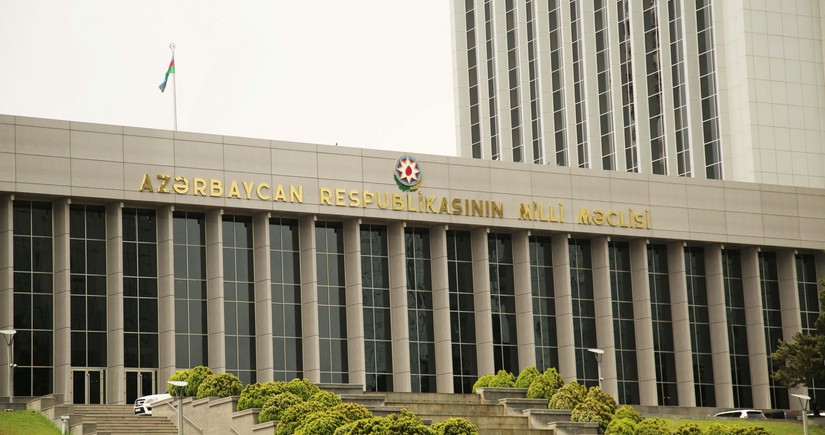
Milli Majlis

Azerbaijan proposes restrictions on social networks for children
Domestic policy

Azerbaijan proposes restrictions on social networks for children

  • 27 February, 2026
  • 10:09
Azerbaijani parliament calls for global recognition of Khojaly genocide
Domestic policy

Azerbaijani parliament calls for global recognition of Khojaly genocide

  • 26 February, 2026
  • 16:51
Khojaly genocide victims commemorated in Kazakhstan
Foreign policy

Khojaly genocide victims commemorated in Kazakhstan

  • 26 February, 2026
  • 14:54
Azerbaijani officials visit Khojaly memorial
Domestic policy Photo

Azerbaijani officials visit Khojaly memorial

  • 26 February, 2026
  • 11:52
34 years pass since Khojaly genocide
Domestic policy

34 years pass since Khojaly genocide

  • 26 February, 2026
  • 00:18
Ombudsman's 2025 report submitted to Azerbaijan's parliament
Milli Majlis

Ombudsman's 2025 report submitted to Azerbaijan's parliament

  • 25 February, 2026
  • 12:34
Fuat Oktay: Azerbaijan-Türkiye cooperation acts as a factor of stability
Milli Majlis Photo

Fuat Oktay: Azerbaijan-Türkiye cooperation acts as a factor of stability

  • 24 February, 2026
  • 19:03
Azerbaijan hosts 10th Azerbaijan-Türkiye-Georgia parliamentary meeting
Milli Majlis

Azerbaijan hosts 10th Azerbaijan-Türkiye-Georgia parliamentary meeting

  • 24 February, 2026
  • 18:33
Azerbaijani Parliament to hold next plenary session on February 27
Milli Majlis

Azerbaijani Parliament to hold next plenary session on February 27

  • 24 February, 2026
  • 13:39
Azerbaijani MP: Capacity of some reservoirs in country drops by 15–35%
Infrastructure

Azerbaijani MP: Capacity of some reservoirs in country drops by 15–35%

  • 24 February, 2026
  • 13:19
New working groups on interparliamentary relations created in Azerbaijani parliament
Milli Majlis

New working groups on interparliamentary relations created in Azerbaijani parliament

  • 24 February, 2026
  • 12:22
Plenary session of Milli Majlis begins, 10 issues on agenda
Milli Majlis

Plenary session of Milli Majlis begins, 10 issues on agenda

  • 24 February, 2026
  • 11:11
King of Eswatini to attend WUF13
Foreign policy Photo

King of Eswatini to attend WUF13

  • 23 February, 2026
  • 18:52
Azerbaijani Ombudsman calls on international community to legally recognize Khojaly genocide
Domestic policy

Azerbaijani Ombudsman calls on international community to legally recognize Khojaly genocide

  • 23 February, 2026
  • 15:28
Azerbaijan exempts rare car imports from taxes
Business

Azerbaijan exempts rare car imports from taxes

  • 23 February, 2026
  • 15:02
Azerbaijan exempts art and antiques imports from VAT
Business

Azerbaijan exempts art and antiques imports from VAT

  • 23 February, 2026
  • 14:44
1 ... 17 18 19 20 21 ... 202

Milli Majlis: Structure, Legislative Power, and Functions

Milli Majlis (officially the Milli Majlis of the Republic of Azerbaijan, azerb. Azərbaycan Respublikasının Milli Məclisi) is the supreme legislative body and unicameral parliament of the Republic of Azerbaijan. Situated in the capital city of Baku, the Milli Majlis holds the core constitutional authority to pass national laws, ratify international treaties, approve the state budget, and oversee executive governance within the framework of a democratic presidential-parliamentary republic.

1. Constitutional Composition and Electoral System

Deputies: The parliament is composed of 125 deputies (members of parliament) elected by direct popular vote through a majoritarian electoral system in single-mandate constituencies.

Term of Office: Members are elected for a term of five years. To be eligible for election, candidates must be citizens of the Republic of Azerbaijan with voting rights, meeting specific residency and age criteria established by the country's Constitution and Electoral Code.

2. Powers and Legislative Authority

The constitutional competencies of the Milli Majlis encompass pivotal matters of state governance:

Lawmaking: Drafting, debating, and adopting civil, criminal, administrative, and economic legislation that forms the legal backbone of the state.

Fiscal Control: Discussing and approving the annual state budget, monitoring its implementation, and ratifying national socioeconomic development programs.

State Appointments: Confirming the appointment of the Prime Minister upon nomination by the President, approving members of the Cabinet of Ministers, and electing judges to higher judicial bodies, including the Constitutional Court and the Supreme Court.

International Affairs: Ratifying and denouncing international treaties, authorizing states of emergency or martial law, and deciding on questions of war and peace.

3. Institutional Organization

Leadership: The legislative body is led by the Speaker of the Milli Majlis, assisted by first deputy and deputy speakers, who manage parliamentary sessions and administrative procedures.

Committees: Work is organized through specialized standing committees (such as committees on legal policy, economic policy, foreign relations, human rights, and regional affairs) where bills undergo rigorous expert review before being submitted for plenary voting.