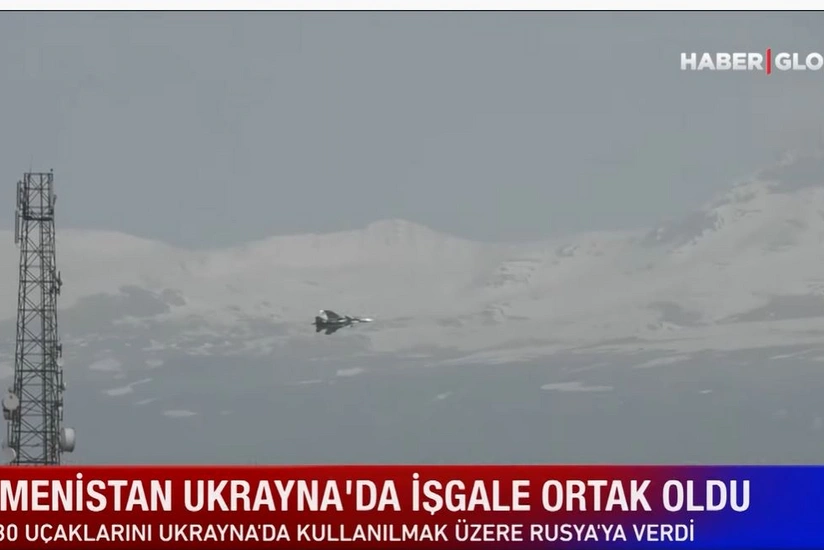
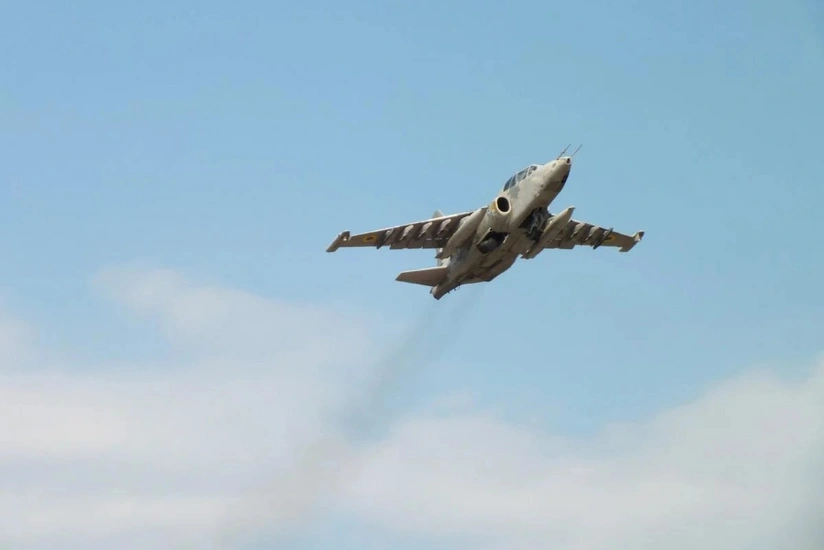
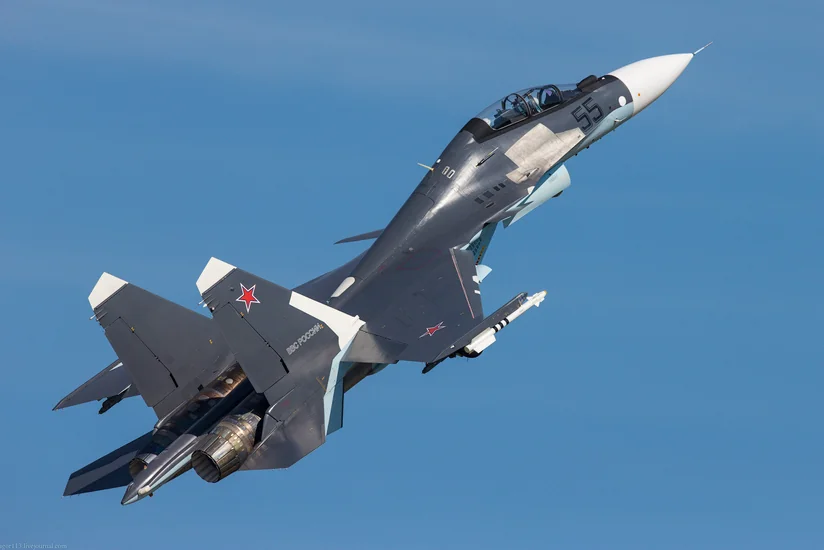
The Su-30 (NATO reporting name: Flanker-C) is a twin-seat, multirole, super-maneuverable fighter aircraft developed by the Sukhoi Design Bureau, based on the Su-27UB combat trainer.
The aircraft was designed to gain air superiority, conduct long-range patrols, escort strategic aviation, provide radar surveillance, guidance, and control, as well as to destroy ground and surface targets in all weather conditions.
Development of the aircraft began in the mid-1980s. The initial objective was to create a long-range interceptor for the Air Defense Forces capable of patrolling vast areas (such as over the Arctic or the Pacific Ocean) for extended periods.
The prototype (T-10PU-5) made its maiden flight in December 1989. During its development, the concept evolved: from a highly specialized interceptor, the Su-30 transformed into a universal combat platform. The inclusion of a second crew member (a Weapon Systems Officer/navigator) allowed for an effective distribution of the workload: while the pilot flies the aircraft and engages in dogfights, the operator is responsible for navigation, target acquisition, and the deployment of precision air-to-surface weapons.
Crew: 2 personnel.
Maximum Takeoff Weight: Up to 34,500 kg.
Powerplant: Two AL-31F turbofan engines (modern versions feature AL-31FP engines with thrust vector control).
Maximum Speed: * At sea level: 1,350 km/h.
At altitude: Up to Mach 2 (approx. 2,120 km/h).
Practical Range: Up to 3,000 km without refueling (up to 5,200 km with in-flight refueling).
Combat Payload: Up to 8,000 kg across 12 hardpoints.
Armament: * Built-in 30mm GSh-30-1 autocannon.
A wide range of air-to-air missiles (R-73, R-27, R-77).
Precision air-to-surface weapons (Kh-29, Kh-31, Kh-59 missiles, KAB-500/KAB-1500 guided aerial bombs).
The Su-30 platform proved to be exceptionally successful on the global arms market, leading to the creation of numerous modifications tailored to specific customer requirements.
Super-maneuverability: Modifications such as the Su-30MKI (for India), Su-30MKM (for Malaysia), and Su-30SM (for the Russian Aerospace Forces and CIS countries) are equipped with canards and thrust vector control (TVC) engines. This allows the aircraft to perform highly complex aerobatic maneuvers (such as "Pugachev's Cobra" or the "Frolov Chakra"), providing a distinct advantage in close-range dogfights.
Avionics and Radar: Modern versions are equipped with phased array radar stations (e.g., the Bars radar) capable of simultaneously tracking up to 15 targets and engaging 4 of them.
Su-30MKK and Su-30MK2: Commercial versions initially developed for the Chinese Air Force and Navy. They feature a reinforced airframe, enlarged fuel tanks, and expanded capabilities for striking ground and naval targets, but they do not have canards or TVC.
The Su-30 is one of the most widely produced and commercially successful heavy fighters in the world. Its various modifications are in service with more than ten countries, including:
Russia
India (the primary operator with over 260 Su-30MKI units)
China
Algeria
Vietnam
Venezuela
Malaysia
As well as several CIS countries (Kazakhstan, Armenia, Belarus).

 Baku 29° C